



Relic dates Jinan founding to around 4,200 years ago









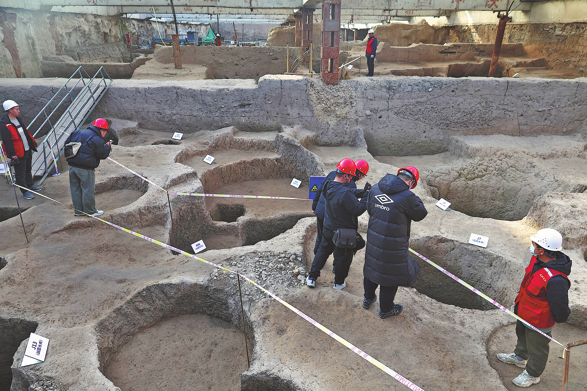
A well-preserved ancient wall unearthed in Jinan has revealed that the capital of Shandong province was established as a city settlement around 4,200 years ago — approximately 1,500 years earlier than previously believed, archaeologists said on Thursday.
The discovery was made at the Daming Lake Southwest Site, first identified in April 2024 during a survey for a subway project.
"The conventional scholarly view dated Jinan's founding to about 2,700 years ago," said Luan Fengshi, a professor at Shandong University's School of Archaeology, during a press conference at the excavation site.
"This Longshan culture city wall fundamentally changes that timeline, pushing it back to approximately 4,200 years before present," he said.
The excavation has uncovered 206 structural features, including defensive walls, moats, platforms, and house foundations. Archaeologists have also recovered over 460 artifacts made from pottery, porcelain, iron, copper, bone, stone, and wood, along with more than 130 coins.
A separate collection of more than 1,000 boxes of ceramic fragments spans the Dawenkou culture from about 5,000 years ago, Longshan culture, Shang Dynasty (c.16th century-11th century BC), Han (206 BC-AD 220), and Tang (618-907) through Qing (1644-1911) dynasties.
"The centerpiece of the discovery is a section of city wall from the Longshan culture. Carbon-14 dating confirms its construction around 4,200 years ago," said Luan.
Inside the city, archaeologists found polished black pottery shards, including an exquisitely decorated piece of eggshell-thin pottery, a hallmark of high-status Longshan craftsmanship.
To the west of the wall is a human-modified moat, originally a natural river channel, measuring over 50 meters wide and nearly 10 m deep.
"The lowest silt layer contained Dawenkou culture pottery, while the upper layers held a greater quantity of Longshan ceramics, helping us trace the site's evolution," said Guo Junfeng, director of the archaeology institute of Jinan.
To the east of the wall lay the remains of city life, with cultural layers indicating activity not only from the Longshan period but also from the subsequent Warring States Period (475-221 BC) and later dynasties.
Another significant finding is the foundation of a Song Dynasty (960-1279) Buddhist temple.
"Combined with earlier discoveries nearby, this confirms a flourishing Buddhist culture in Jinan," Guo said, adding it provides crucial physical evidence for researching the development of Buddhism, temple architecture, and social beliefs of the time.
The site is now poised for preservation and public education. Archaeologists have already conducted 3D scanning and digital documentation of key features and have removed a cross-section of the ancient wall for further study.
"We plan to construct an on-site exhibition space to showcase these 4,000-year-old remains and share the story of this discovery with the public," said Ren Xiaorui, deputy director of the Jinan bureau of culture and tourism.
zhaoruixue@chinadaily.com.cn






- Relic dates Jinan founding to around 4,200 years ago
- New rocket set to debut soon, launch six satellites
- Taiwan's character of the year a vote against confrontation
- Wave of freezing weather brings snow to northern China
- APEC 'China Year' kicks off at Shenzhen meeting
- HKSAR chief executive says to conclude residential complex fire probe within 9 months